





What Are AI Agents in Crypto?
AI agents are starting to sit between traders and the crypto markets, turning plain‑language requests or signals into on‑chain actions.
If you are a trader with some experience, understanding how AI agents in crypto work will help you judge which tools are useful, where the risks are, and how these new platforms fit into the wider Web3 stack.
AI agents in crypto: a simple definition
In plain English, an AI agent in crypto is a software program that can:
- Observe data (prices, order books, on‑chain activity, news, social feeds)
- Reason about that data using AI models
- Take actions through tools (exchanges, wallets, smart contracts) with some level of autonomy
Think of an AI agent as a junior trader plus an execution bot wrapped into one system:
- The “brain” is an AI model (for example a large language model, or LLM) that interprets context, runs checks, and chooses what to do next.
- The “hands” are the tools and integrations: CEX APIs, DEX routers, DeFi protocols, or on‑chain contracts the agent can call.
Traditional trading bots follow fixed rules you hard‑code in advance. AI agents aim to be more flexible: they can adapt to new information, combine multiple tools, and handle open‑ended tasks like “monitor this wallet and hedge my exposure if volatility spikes.”
How AI agents in crypto work (step by step)
Different platforms implement agents in different ways, but most follow a similar flow.
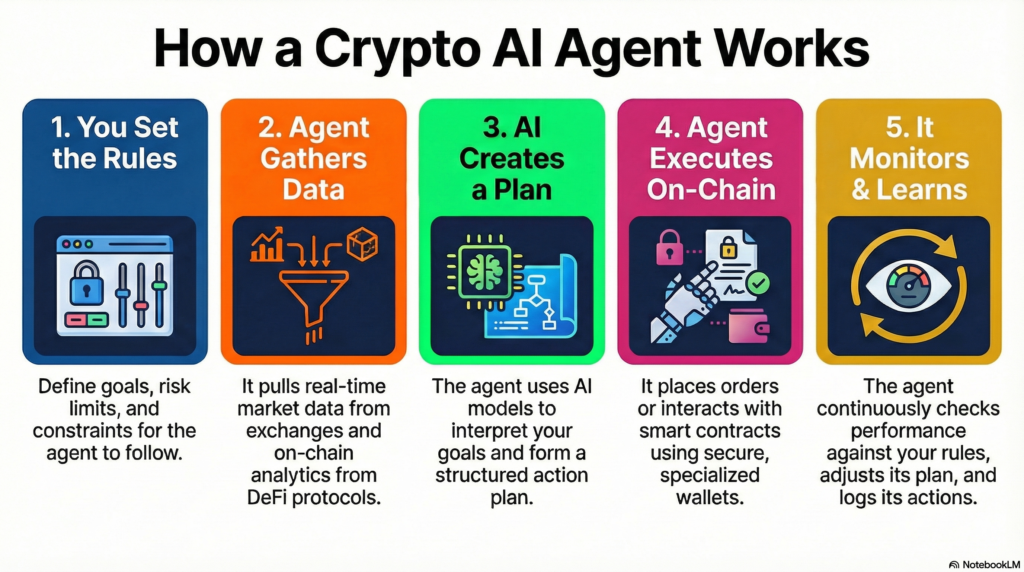
1. Input or intent
Every agent starts from an “intent” – either from a human or from the environment:
- Human intent: You type something like “rebalance my portfolio to 60% BTC, 30% ETH, 10% stablecoins over the next week.”
- Market/event intent: The agent is configured to wake up when specific conditions are met, such as funding rates widening, gas fees dropping, or a new governance proposal going live.
2. Data collection
The agent then pulls in the data it needs. This can include:
- Centralized exchange order books and trade history
- On‑chain data (DEX volumes, liquidity, wallet flows, lending utilization)
- Off‑chain signals like news headlines or social sentiment
- User portfolio data from wallets or custodians (where permissions are granted)
Some agent platforms specialize in this data layer, offering pre‑built connections to price feeds, block explorers, and analytics dashboards so agents can query them directly.
3. Reasoning and planning
The AI “brain” interprets the intent and the data, then plans a sequence of actions. Examples:
- Breaking a large order across venues to reduce slippage
- Choosing between spot, perp, or options for a hedge
- Deciding which DeFi protocol to use based on yield, TVL, and risk constraints
This step often involves:
- Rule logic: Hard constraints like position limits, max leverage, or KYC requirements.
- Machine learning models: For pattern recognition, forecasts, or anomaly detection.
- Language models (LLMs): For interpreting natural language, summarizing data, or orchestrating tools.
4. Action selection
Once the agent has a plan, it chooses specific actions, such as:
- Place, modify, or cancel orders via exchange APIs
- Route swaps through DEX aggregators
- Deposit, borrow, or unwind positions in DeFi protocols
- Draft risk reports, alerts, or summaries for the human trader
On some platforms, you keep a human in the loop. The agent proposes actions, but you confirm each trade or batch. Other setups allow higher autonomy within pre‑defined limits.
5. Execution and settlement
The agent then executes through whatever rails it has been given:
- Centralized rails: API keys on CEXs with scoped permissions and IP whitelists.
- On‑chain rails: Smart contracts it can call, often via a delegated key or a “session wallet” with limited permissions.
- Hybrid: The agent decides off‑chain but settles trades on‑chain for transparency and auditability.
6. Feedback and learning
After execution, the agent logs results and may update its behavior:
- Tracking P&L, slippage, and execution quality
- Adjusting parameters based on recent performance and risk
- Flagging conditions where it should back off and alert a human
This feedback loop is what separates more advanced AI agents from basic rule‑based bots.
Real-world examples and use cases for traders
Here are some ways traders are already experimenting with AI agents in crypto.
1. Research and market intelligence copilots
- Summarize long research threads, governance proposals, or protocol docs into short briefs.
- Surface unusual on‑chain flows (for example, large wallet moves into or out of a token).
- Turn questions like “What changed in this DeFi protocol over the last 24 hours?” into structured reports.
2. Risk monitoring and alerts
- Watch your open positions, collateral ratios, and liquidation levels across venues.
- Generate natural‑language alerts when volatility regimes change or when certain thresholds are hit.
- Highlight correlated risks, such as multiple positions depending on the same stablecoin or oracle.
3. Execution and routing agents
- Break up orders and route them through CEXs and DEXs to improve fills within user‑defined constraints.
- Select the timing and venue of execution based on liquidity, spread, and gas costs.
- Provide explanations like “I routed 60% via DEX A and 40% via CEX B due to depth and fees.”
4. DeFi automation and portfolio maintenance
- Maintain target allocations between majors, long‑tail assets, and stablecoins.
- Automate simple strategies like periodic rebalancing or rolling yield positions, within caps you define.
- Move liquidity when incentives change, while enforcing risk rules such as protocol allow‑lists.
5. Agent platforms you’ll see in the wild
Today’s “agent platforms” in crypto generally fall into a few categories:
- Trading and analytics copilots: Interfaces where you chat with an AI that is connected to rich on‑chain and market data, and over time may gain limited trading permissions.
- On‑chain agent networks and L1s: Blockchains or layers designed so agents can hold keys, manage wallets, and execute cross‑chain actions with built‑in security and intent handling.
- Agent launchpads and marketplaces: Platforms where creators deploy agents as on‑chain assets (for example, social agents, DeFi bots, or assistants) that users can interact with or hold exposure to.
- Coordination and settlement protocols: Infrastructure that lets agents form contracts with each other, share data, and settle rewards or fees on‑chain.
Names and architectures will change quickly, but most projects are trying to solve variations of these same problems: safe execution, flexible tooling, and clear incentives.
Benefits and limitations
Potential benefits
- Speed and coverage: Agents can watch more markets, protocols, and wallets than a human can track manually.
- Consistency: Once rules and boundaries are set, an agent does not get tired, emotional, or distracted.
- Better UX: Chat‑based or intent‑based interfaces can hide complex signing flows, bridging steps, and contract interactions.
- Composability: Multiple specialized agents (data, analysis, execution, risk) can collaborate instead of one monolithic bot.
Limitations and risks
- No guarantee of profitable strategies: An AI model can still make poor decisions, overfit to recent data, or misread market conditions.
- Model errors and “hallucinations”: Agents built on LLMs can occasionally produce confident but incorrect outputs. If wired directly to execution, this can be dangerous.
- Smart contract and integration risk: Bugs or vulnerabilities in the contracts, bridges, or APIs the agent uses can lead to losses.
- Key and permission management: Giving an agent signing power or API access creates new attack surfaces. Mis‑scoped permissions can be costly.
- Regulatory and compliance uncertainty: It is still unclear how fully autonomous trading or cross‑border actions by agents will be treated in many jurisdictions.
For now, many serious traders treat agents as advanced assistants or co‑pilots instead of fully autonomous money managers.
Common beginner misconceptions
- “AI agents are magic money printers.”
Even sophisticated agents cannot change market structure, liquidity, or slippage. They execute strategies; they do not remove risk. - “Agents are just rebranded trading bots.”
Classic bots follow fixed rules. Agents aim to combine flexible reasoning, multi‑step planning, and a variety of tools. In practice, many current products sit somewhere in between. - “Full autonomy is already solved.”
Reality: most production systems still keep strong guardrails and human approval for critical actions. Research shows autonomous agents struggle with live, noisy markets. - “If it is on‑chain, it must be safe.”
On‑chain transparency helps with auditability, but it does not guarantee that an agent’s strategy, parameters, or integrations are sound. - “Every agent needs its own token.”
Some platforms issue tokens; others monetize through fees or subscriptions. A token is not a requirement for an AI agent to function.
How AI agents fit into the broader Web3 ecosystem
To understand where AI agents sit in Web3, it helps to think in layers.
- Base blockchains: Provide settlement, consensus, and security. Agents use them to record actions, hold assets, and prove what they did.
- Smart contract protocols: DEXs, money markets, derivatives platforms, and NFT marketplaces give agents places to act.
- Data and oracle layers: Price feeds, indexers, and analytics tools give agents the state of the world they need to reason about.
- Identity and reputation: Wallets, on‑chain profiles, and reputation systems help distinguish long‑lived, accountable agents from disposable ones.
- Coordination and governance: DAOs and multisigs can delegate specific tasks to agents (monitor treasury positions, draft proposals, simulate scenarios).
Zooming out, many researchers describe an emerging “agentic web” – a network of AI agents that discover each other, communicate, and coordinate across services. In that picture, blockchains act as a neutral settlement and accountability layer where agents can prove actions and exchange value without needing to trust a central intermediary.
What to explore next
If you want to go deeper as a trader, the next useful topics include:
- A beginner’s guide to on‑chain data for traders
- How smart contracts and DeFi protocols actually execute trades
- Risk management basics for algorithmic and automated strategies
- The differences between simple trading bots, signal providers, and full AI agents
- Security checklists before connecting wallets or API keys to any agent platform
Key takeaways
- AI agents in crypto are autonomous programs that combine market data, AI reasoning, and execution tools to act on intents.
- They can assist with research, risk monitoring, execution, and DeFi automation, but come with model, integration, and security risks.
- Most current systems work best as co‑pilots with clear limits and human oversight, not as fully independent money managers.
- In the broader Web3 stack, agents sit on top of blockchains and protocols, using them as neutral rails for settlement, identity, and coordination.
As the tooling matures, traders who understand how these agents really work – and where they can fail – will be better positioned to evaluate new platforms and use them responsibly.
FAQ: AI agents in crypto
Are AI agents in crypto the same as trading bots?
No. Traditional trading bots follow fixed, predefined rules. AI agents aim to be more flexible: they can analyze a wider range of data, plan multi‑step actions, and sometimes adapt their behavior over time. In practice, many products mix both approaches.
Can I trust an AI agent to trade for me without supervision?
You should be cautious. Models can make mistakes, misread data, or behave unexpectedly in volatile markets. Many experienced traders start by using agents for research, alerts, or paper trading before granting limited execution rights under strict constraints.
Do AI agents guarantee better performance than manual trading?
No tool can guarantee performance. Agents can help you process more information and enforce discipline, but outcomes still depend on strategy design, risk management, and market conditions.
What permissions should I give an AI agent platform?
Only give the minimum required permissions. On CEXs, that often means separate API keys with restricted scopes and withdrawal disabled. On‑chain, consider using wallets or smart accounts with spending limits, time locks, or allow‑lists instead of your main holdings.
How do I evaluate an AI agent platform before using it?
Look at the team’s transparency, security practices, smart contract audits, permission model, logging and monitoring features, and how easy it is to keep a human in the loop. Treat any performance claims with skepticism and test with small, non‑critical capital first.