




What Is a Layer 2? A Beginner’s Guide to Crypto Scaling
If you have ever tried to use Ethereum during a busy market cycle, you likely encountered a frustrating problem: high transaction fees and slow processing times. This happens because popular blockchains often struggle to handle thousands of users at once.
This is where Layer 2 solutions come in. They are designed to solve the “traffic jam” problem without replacing the main blockchain. Instead of clogging up the main network, they handle the heavy work separately and report back the results.
In this guide, you will learn exactly what a Layer 2 is, how it works, and why it is essential for the future of the Web3 ecosystem.
The Simple Definition
A Layer 2 (L2) is a secondary framework or protocol that is built on top of an existing blockchain system. The main blockchain, such as Ethereum or Bitcoin, is referred to as Layer 1 (L1).
Think of Layer 1 as the main highway. When too many cars (transactions) try to use it at once, traffic comes to a standstill, and tolls (gas fees) skyrocket. A Layer 2 is like an express lane or a flyover built directly on top of that highway. It allows traffic to move faster and cheaper, but it still follows the same general route and effectively ends at the same destination.
The primary goal of a Layer 2 is to increase transaction speed (throughput) and lower costs while inheriting the security of the main underlying blockchain.

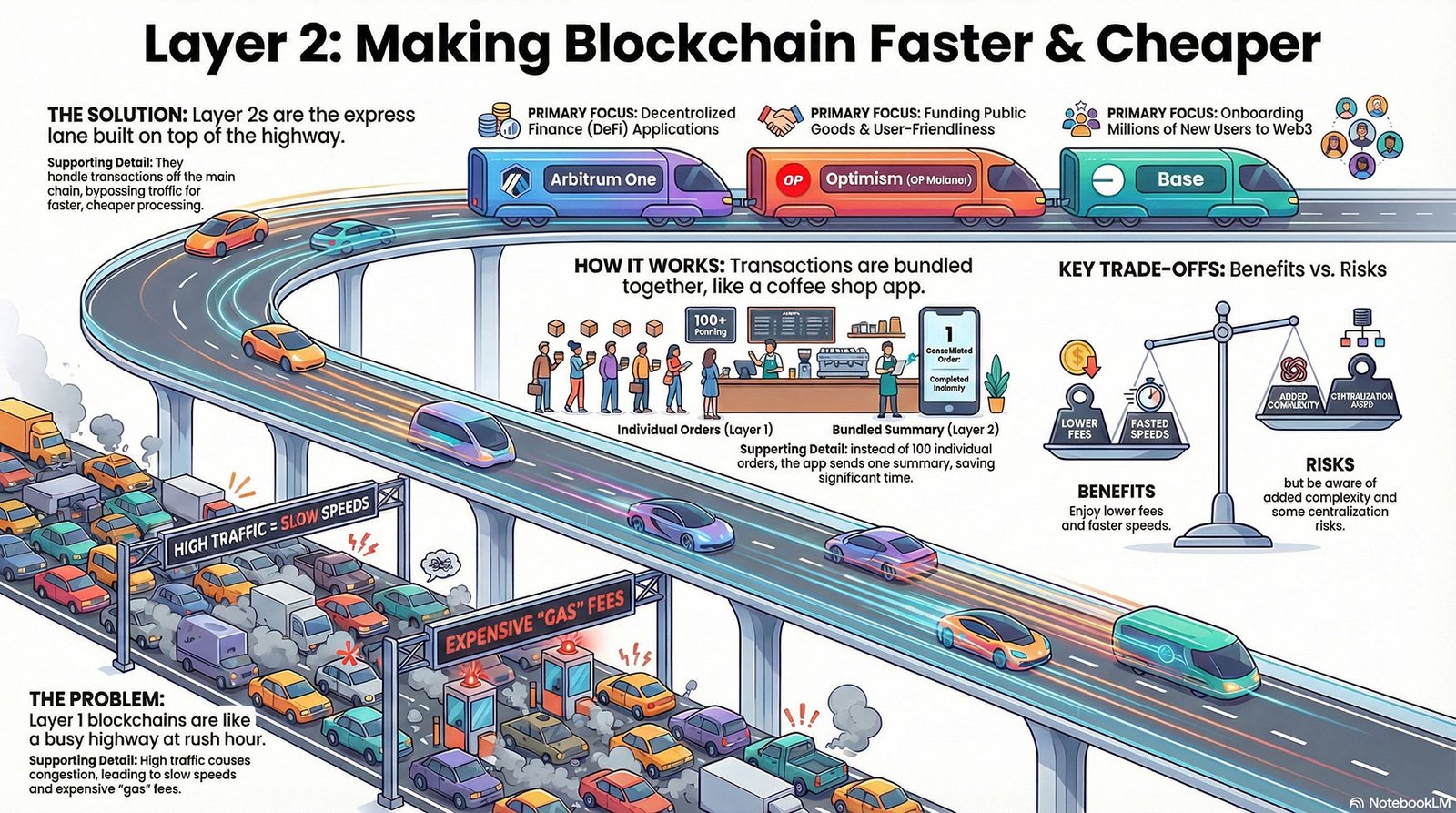
How Layer 2 Works: The “Bar Tab” Analogy
To understand the mechanics without getting bogged down in technical jargon, imagine opening a tab at a busy bar.
1. Opening the Tab (Entering Layer 2)
If you paid for every single drink individually with a credit card, you would waste time waiting for the machine to process each transaction. This is like transacting directly on Layer 1—slow and inefficient for small, frequent actions.
2. Ordering Drinks (Transacting on Layer 2)
Instead, the bartender writes your orders on a piece of paper. You can order ten drinks in rapid succession. These “transactions” are happening off the main record (your bank statement) and are just between you and the bartender for now. This is where Layer 2 networks process thousands of transactions per second for a fraction of the cost.
3. Closing the Tab (Settling on Layer 1)
At the end of the night, you pay the total bill in one single transaction. Your bank sees just one charge, even though you ordered ten drinks. Similarly, Layer 2 networks bundle (or “roll up”) hundreds of user transactions into a single bundle and submit that one bundle to the main blockchain [ethereum.org](https://ethereum.org/en/layer-2/learn/).
Real-World Examples of Layer 2
While the concept can apply to various blockchains, it is most prominent in the Ethereum ecosystem. Developers have created different types of L2s, primarily known as “Rollups.”
- Optimistic Rollups: These assume transactions are valid by default to speed things up. They only run checks if someone challenges a transaction. Examples include Arbitrum and Optimism [forbes.com](https://www.forbes.com/sites/digital-assets/article/what-is-layer-2/).
- Zero-Knowledge (ZK) Rollups: These use complex mathematics to prove transactions are valid before bundling them. They are often viewed as more secure but technically harder to build. Examples include zkSync and Polygon zkEVM.
In the real world, you might use these networks to trade tokens on a decentralized exchange or play a blockchain game. The experience feels exactly like using Ethereum, just significantly faster and cheaper.
Benefits and Limitations
Layer 2 solutions are a massive upgrade for crypto users, but they are not perfect.
The Benefits
- Lower Fees: Because the cost of the main blockchain knowing about the transaction is shared among hundreds of users in a bundle, fees can drop from $10.00 to under $0.10.
- High Speed: Transactions often confirm in seconds rather than minutes.
- Security: unlike a completely separate blockchain (like a sidechain), a true Layer 2 relies on the main blockchain for its final security [coinshares.com.com](https://coinshares.com/corp/insights/knowledge/understanding-layers-0-1-2-and-3-key-differences-explained/).
The Limitations
- Complexity: Moving your assets from Layer 1 to Layer 2 (“bridging”) can be confusing for beginners and introduces a point of vulnerability.
- Fragmentation: If you have money on Arbitrum and your friend is on Optimism, sending funds between them is not as direct as sending them on the main Ethereum network.
- Centralization Risks: Many Layer 2 networks use a centralized “sequencer” to bundle transactions. If this computer goes down, the network might temporarily halt, although funds usually remain safe on the main chain.
Common Beginner Misconceptions
Misconception 1: “Layer 2 is a new cryptocurrency.”
Not necessarily. While some L2s have their own “governance tokens” (used for voting), the network itself uses the Layer 1 token (like ETH) to pay for transaction fees. You do not always need to buy a new coin to use an L2.
Misconception 2: “Layer 2 is less secure.”
True Layer 2s inherit the security of the main underlying blockchain. As long as Ethereum (Layer 1) is secure, the data settled on it from Layer 2 is also secure. However, the mechanism that moves money there (the bridge) can sometimes have risks.
How This Fits into the Web3 Ecosystem
The “Blockchain Trilemma” states that a blockchain can usually only be two of the following three: Decentralized, Secure, or Scalable [coinshares.com](https://coinshares.com/corp/insights/knowledge/understanding-layers-0-1-2-and-3-key-differences-explained/).
Layer 1 networks like Bitcoin and Ethereum prioritize Decentralization and Security. They accept that they will be slow (not Scalable) to ensure no one person controls the network.
Layer 2 networks fill the Scalability gap. They allow the Web3 ecosystem to grow from thousands of users to millions of users without compromising the foundational security of the main network.
Conclusion
A Layer 2 is simply a helper network that makes blockchains usable for the masses. By processing transactions off the main chain and bundling them together, they offer the speed and low costs of a standard web application while keeping the security of a blockchain.
As you explore crypto, you will likely spend most of your time transacting on Layer 2 networks, using Layer 1 only as a “savings account” or settlement layer. Understanding this distinction is your first step toward mastering the modern Web3 landscape.
Frequently Asked Questions
Is Layer 2 safe to use?
Generally, yes. True Layer 2 networks derive their security from the main blockchain (Layer 1). However, you should always be careful when “bridging” assets and use reputable networks that have been tested over time.
Do I need to buy a specific token to use a Layer 2?
Usually, no. Most Ethereum Layer 2s use ETH for gas fees (transaction costs). Some networks have their own tokens for voting on upgrades, but you typically pay for your transactions using the same asset you use on the main network.
What is the difference between a Sidechain and a Layer 2?
A Layer 2 posts its data back to the main blockchain for security. A sidechain runs parallel to the main chain but is responsible for its own security. If a sidechain is attacked, the main chain cannot protect it, whereas a Layer 2 is protected by the main chain’s consensus.