




Smart Contracts Explained: A Beginner’s Guide to Digital Agreements
Imagine buying a house without a pile of paperwork or receiving an insurance payout instantly without waiting for an agent to approve your claim. This is the potential reality powered by smart contracts.
For decades, traditional agreements have relied on middlemen like banks, lawyers, and brokers to build trust. Smart contracts replace that need for human intermediaries with code that guarantees execution.
In this guide, we will break down exactly what smart contracts are, how they work using a simple vending machine analogy, and why they are considered the building blocks of the Web3 world.
What Is a Smart Contract?
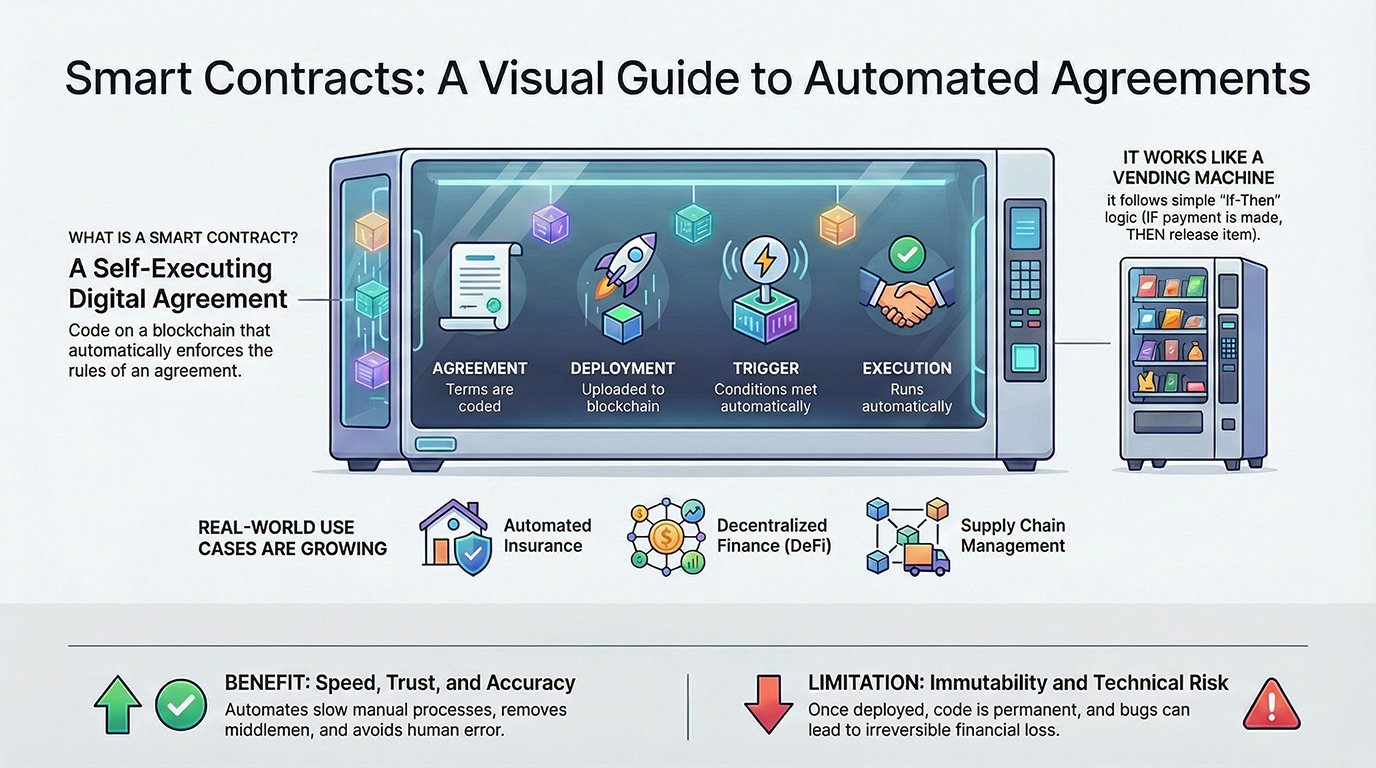
At its core, a smart contract is a computer program stored on a blockchain that automatically runs when specific conditions are met. It is a digital agreement that executes itself.
Unlike a traditional paper contract, a smart contract does not rely on a third party to enforce the rules. Instead, the code defines the rules, and the blockchain ensures those rules are followed exactly as written.
According to ethereum.org, you can think of it as a collection of code (functions) and data (state) that resides at a specific address on the blockchain.
How Smart Contracts Work
To understand the mechanics without getting technical, let’s look at the most famous analogy for smart contracts: the Vending Machine.
The Vending Machine Analogy
Think about how a vending machine works compared to a small shop:
- The Shop (Traditional Contract): You hand money to a clerk. The clerk verifies the amount, checks if the item is in stock, and hands it to you. You rely on the clerk to be honest and efficient.
- The Vending Machine (Smart Contract): You insert money and press a specific button. The machine automatically dispenses the snack. There is no clerk. The process is hard-coded: If money inserted equals price AND selection is made, THEN release snack.
Smart contracts operate on this same “If/Then” logic. Once deployed to a blockchain, they run autonomously.
The Step-by-Step Process
- Agreement: Developers write the terms of the agreement into code (e.g., “If User A sends 1 ETH, send them Digital Token B”).
- Deployment: This code is uploaded to a blockchain network like Ethereum.
- Trigger: An event happens, like a transaction being sent or a date being reached.
- Execution: The computers (nodes) on the network run the code. If the conditions are met, the action is performed instantly.
- Settlement: The result is recorded on the blockchain ledger and cannot be changed.
Real-World Use Cases
Smart contracts are already being used to reinvent industries by removing inefficiencies. Here are practical examples:
1. Automated Insurance
In traditional insurance, claiming a payout for a delayed flight can take weeks. With a smart contract, the policy exists as code connected to flight data. If your flight is delayed by more than 2 hours, the smart contract automatically triggers and deposits a refund into your wallet. No forms, no waiting.
2. Decentralized Finance (DeFi)
Banks usually act as middlemen for lending and borrowing. Creating a huge industry explained by academy.binance.com, DeFi platforms use smart contracts to let users lend funds to others. The contract holds the collateral and automatically manages interest rates and repayments.
3. Supply Chain Management
A smart contract can track a product from the factory to the store. When a shipment arrives at a port and is scanned, the contract can automatically release payment to the supplier and update the inventory log, reducing disputes and paperwork.
Benefits and Limitations
While powerful, smart contracts are a developing technology with both clear advantages and significant risks.
Benefits
- Speed: Processes that used to take days are executed in seconds or minutes.
- Trustlessness: You do not need to trust the other person or a middleman; you only need to trust the code.
- Accuracy: Automated execution avoids human errors in processing forms or calculations.
Limitations
- Immutability: Once deployed, a smart contract usually cannot be changed. If there is a mistake in the code, it is difficult or impossible to fix.
- Technical Risk: Bugs or “exploits” in the code can lead to loss of funds, as the blockchain will execute the code exactly as written, even if it was written with an error.
- Legal Status: As noted by bitzuma.com, smart contracts are not necessarily legally binding “contracts” in a court of law in all jurisdictions.
Common Beginner Misconceptions
Misconception 1: They are intelligent AI
Despite the name, smart contracts are not “smart” in the sense of Artificial Intelligence. They cannot “think” or make subjective decisions. They simply follow strict, pre-written logic.
Misconception 2: They can access any data
Blockchains are closed loops. A smart contract on Ethereum cannot simply “Google” the weather or the price of gold. They often require tools called Oracles (like Chainlink) to feed real-world data into the blockchain securely.
Role in the Web3 Ecosystem
Smart contracts are the engine room of Web3. They serve as the backend logic for:
- DApps (Decentralized Applications): Apps that run on a blockchain instead of a centralized server.
- DAOs (Decentralized Autonomous Organizations): Internet-native groups managed by code rather than corporate executives.
- NFTs (Non-Fungible Tokens): Proof of ownership for digital items is managed via smart contracts.
Conclusion
Smart contracts represent a shift from “trusting people” to “trusting code.” By automating agreements using simple logic, they allow strangers to transact securely without expensive intermediaries.
As you continue your Web3 journey, remember that while smart contracts offer incredible efficiency, they are only as good as the code they are written in. Always take time to understand the platforms you interact with.
What to explore next
Now that you understand smart contracts, you might want to learn about Gas Fees (the cost to run these contracts) or explore Decentralized Applications (DApps) to see them in action.
Frequently Asked Questions (FAQ)
Do I need to know how to code to use a smart contract?
No. Most user-friendly applications (DApps) provide a simple button interface. When you click “Swap” or “Buy,” the application interacts with the smart contract code for you.
Can a smart contract be deleted?
Generally, no. Once deployed to a blockchain, the code is permanent (immutable). However, developers can sometimes build in “self-destruct” features or create upgradeable contracts, though this is less common.
Who controls a smart contract?
No single person controls a strictly decentralized smart contract once it is deployed. It is controlled by the logic written in its code and the actions of the users interacting with it.